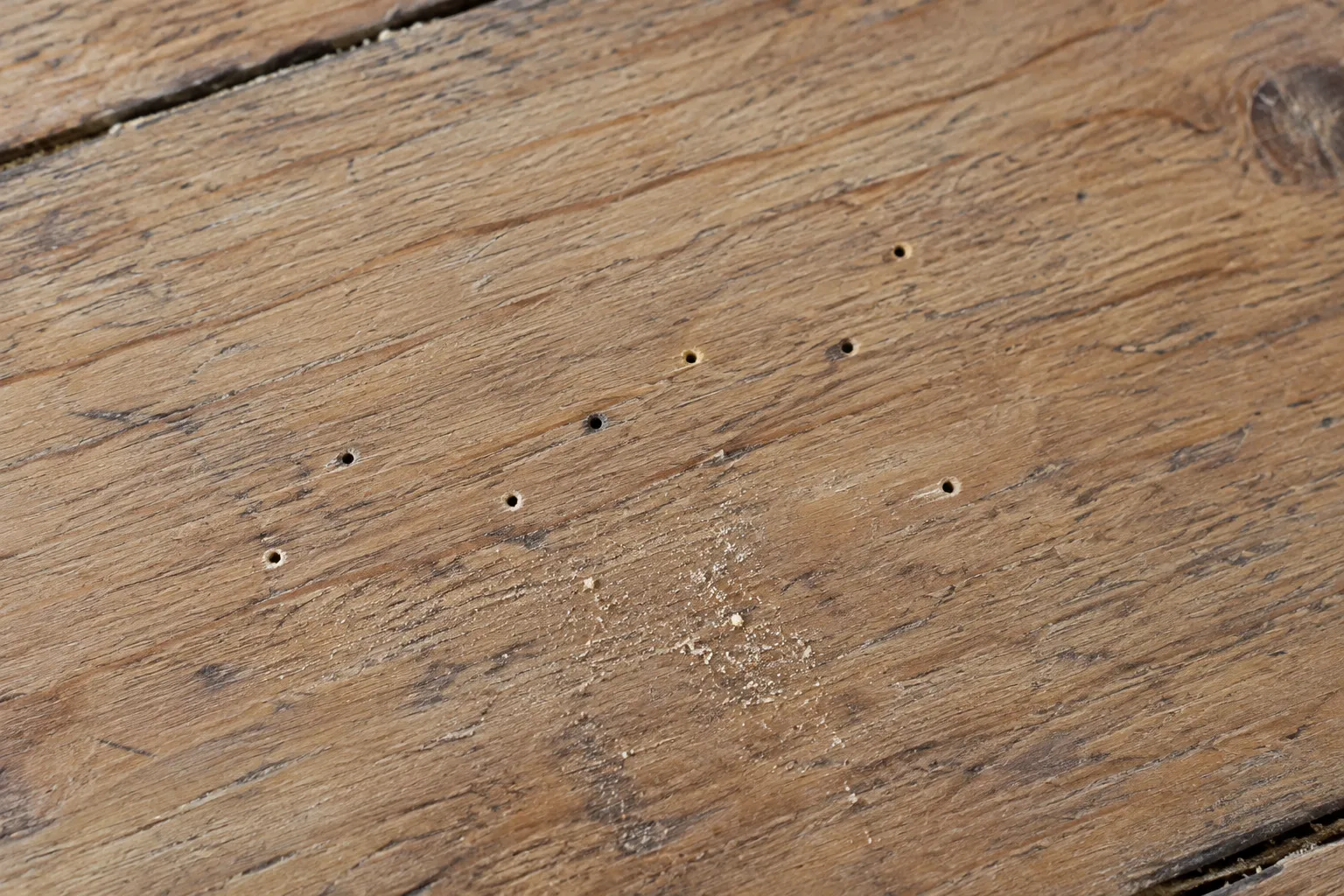
Borer holes are the exit holes adult borer beetles chew when they leave the wood. Small round holes about 1 to 2 mm across, with fine powder underneath, are the classic sign of the common house borer. One hole means a larva has already spent years tunnelling inside, so there's usually more damage than you can see. This page is part of our guide to borer treatment in Auckland. It explains how to read the holes and dust, how to tell if the borer is still active, and what to do about the damage.
What do borer holes look like?
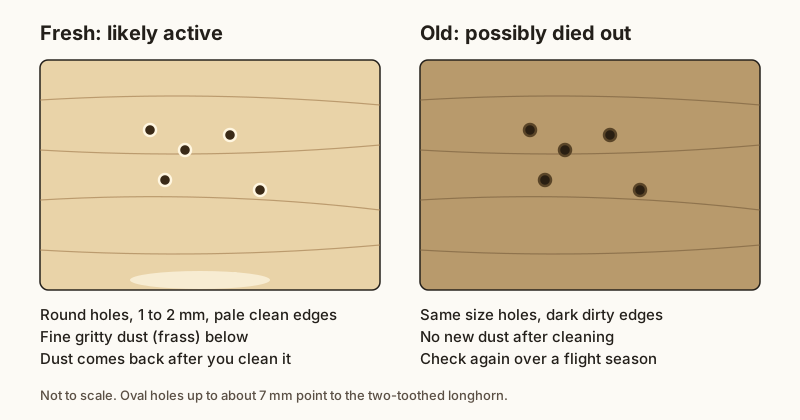
Borer holes from the common house borer are small and round, about 1 to 2 mm across, a bit smaller than a match head. They're often in clusters, with little piles of fine, gritty dust called frass underneath. Fresh flight holes have clean, pale edges. Old ones go dark and dirty. Oval holes up to about 7 mm wide point to the two-toothed longhorn.
What the holes and dust tell you:
| What you see | What it usually means |
|---|---|
| Round holes, 1 to 2 mm, pale clean edges | Common house borer, recently active |
| Round holes with dark, dirty edges, no new dust | Older damage, possibly no longer active |
| Oval holes, up to about 7 mm | Two-toothed longhorn |
| Fine dust (frass) that comes back after cleaning | Larvae still feeding inside |
| Timber that's soft or crumbles when pressed | Serious damage, may need replacing |
What kind of bugs cause holes in wood?
In New Zealand homes, small round holes in wood are almost always from the common house borer or the very similar native borer. Larger oval holes come from the native two-toothed longhorn. Powderpost beetles leave tiny holes and very fine, flour-like dust, mostly in hardwoods. Pinholes in logs or green timber are often from ambrosia beetles, which attacked the tree before it was cut.
The timber that gets attacked tells you something too. The common house borer eats the softer sapwood, so untreated pine, older native timbers and the edges of boards are usually hit first. Hardwood flooring with very fine powder is more likely to be powderpost beetle.
Are borer holes a sign of active borer?
Borer holes on their own don't prove the borer is active. Holes stay in the wood forever, so you can be looking at damage from decades ago. Fresh holes with pale edges, new piles of fine dust, or small brown beetles near windows in the warmer months are what show live borer. If you're unsure, clean the area and check again over a flight season.
How to check:
- Vacuum up all the dust around the holes.
- Put masking tape or a light coat of wax over a group of holes.
- Check again over the flight season, roughly October to March for the common house borer.
- New dust, or holes through the tape, means the borer is still active.
How serious is borer damage?
Borer damage starts small and gets serious slowly. A few holes in a floorboard aren't a structural problem. Decades of untreated borer can riddle floor joists, bearers and piles with tunnels until they lose strength. Timber that's soft, crumbly or sags under weight needs strengthening or replacing, not just treatment. Borer in weatherboards often means damage behind them too.
Consumer NZ advises that minor or early infestations can be treated, and badly weakened timber should be strengthened or replaced. When weatherboards show borer, it suggests replacing the affected boards and treating the framing behind while the wall is open.
Can you fill or paint over borer holes?
Yes, you can fill or paint over borer holes, but only after the borer has been treated. Filling first hides new holes, so you won't know if it's still active. Once the timber is treated and you've checked through a flight season, fill the holes with a wood filler or putty that suits the finish, sand flat, and paint or varnish as usual.
Two things to watch:
- Treat before you paint. Residual borer treatments must go on bare wood. Once it's painted, the only option is injecting the holes.
- Don't fill structural damage. Filler hides holes but doesn't add strength. Soft joists and bearers need replacing.
Our guide on how to treat borer covers treating the timber before you repair it.
Questions people ask
How do you get rid of borer?
You get rid of borer by putting a residual borer treatment on the bare timber where it's active, injecting flight holes in painted or varnished wood, and fixing any damp. Bombs and fogging only kill flying adults. In the subfloor and roof void, a professional treatment covers the most ground. Badly damaged timber needs replacing.
What kills borer beetles?
Borer beetles are killed by insecticide that they touch as they leave the wood or lay their eggs. A long-lasting residual treatment on bare timber does that for years. Bombs and fogging kill the adults flying around during the flight season. Neither reaches larvae deep in the wood straight away, which is why a residual treatment matters.
What is borer dust?
Borer dust, called frass, is the fine, gritty powder that falls out of borer holes. It's chewed wood that the larvae have passed as they tunnel. Fresh dust is pale and comes back after you clean it up, which means the borer is active. Old, dark dust that never returns usually means the borer has died out or been treated.
What is shot hole borer?
The polyphagous shot hole borer is a tiny beetle that attacks living trees, not house timber. It has caused serious damage to trees in parts of Australia, including Perth, and in South Africa. Signs are small holes in trunks and branches, and branches dying back. If you see unusual damage like this on trees, report it to the Ministry for Primary Industries on 0800 80 99 66.
Should I buy a house with borer holes?
Many older Auckland houses have some borer holes, and that alone doesn't rule a house out. What matters is whether the borer is active and whether the timber is still sound. Ask a building inspector to check the subfloor, roof void and weatherboards, and get a quote for any treatment or repairs before you commit.
Sources
Last updated